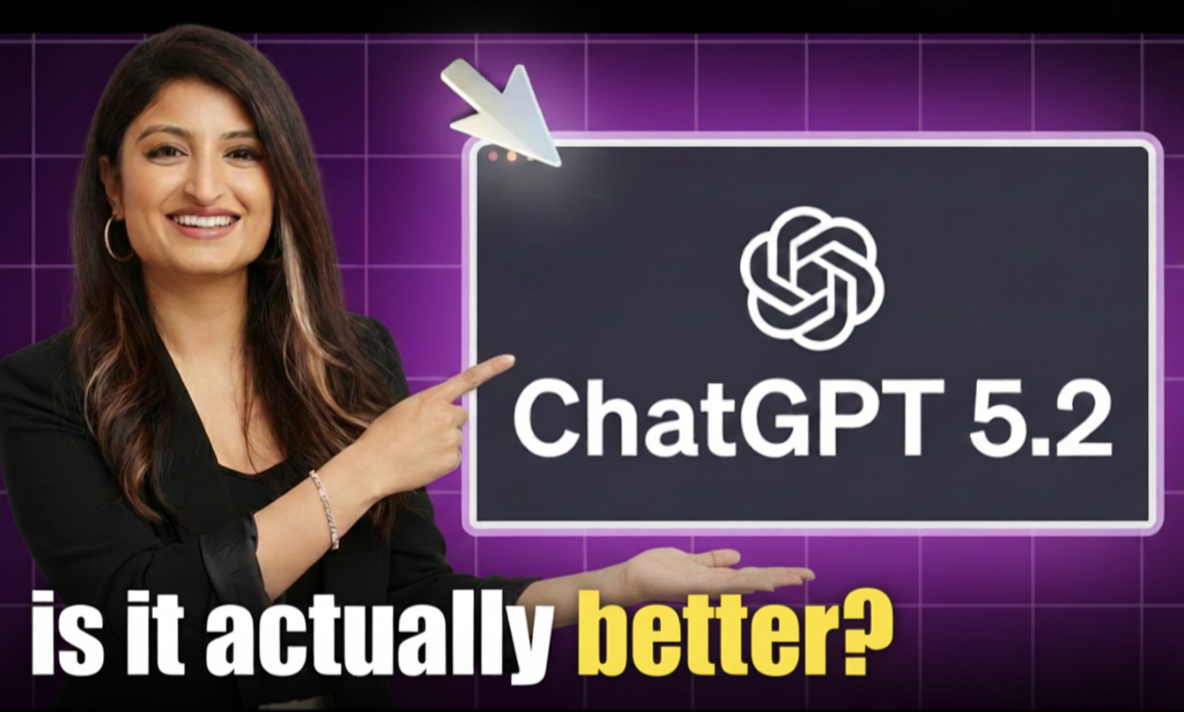
A practical breakdown of GPT-5.2 for busy professionals who use AI at work. Learn where it saves time, where it slows you down, and how to decide if it fits your workflow.Quick Snapshot
Persona: Non-technical business professionals, team leads, consultants, operators
Use case: Daily AI-assisted work, research, writing, analysis, and light coding
Core question: Is GPT-5.2 worth using for real work, not demos
GPT-5.2 Is Here: What It Actually Means for Your Work
OpenAI just rolled out GPT-5.2, and people have…well, opinions about it.
Sam Altman called it “the smartest generally-available model in the world” on X. Meanwhile, actual users are flooding Reddit saying it feels “boring” and “too corporate.” So what’s really going on here, and more importantly, should you care?
Let me break down what this means for those of us using AI to get real work done.
The Promise: Real Time Savings
Here’s what caught my attention in the early reports. According to data from enterprise users analyzed by Geeky Gadgets, people are seeing:
Box AI shared a specific example: data extraction tasks that used to take 46 seconds now finish in 12 seconds. That’s the kind of improvement that actually changes your workflow!
OpenAI claims GPT-5.2 beats human experts 70.9% of the time across 44 different professions. That’s nearly double what the previous version could do at 38.8%.
On paper, this looks fantastic…
….But there’s a little more to the story.
The Reality Check: What Users Are Actually Saying
Within 24 hours of launch, the ChatGPT Reddit community lit up with complaints. And they’re not about bugs or technical issues. They’re about how it feels to use.
The top comments? Things like “Too corporate, too ‘safe’. A step backwards from 5.1” and “Boring. No spark. Feels like a corporate bot” and “It’s so… robotic.”
Now, you might be thinking who cares about personality if it gets the job done?
Fair question. But here’s the thing. The tool you’ll actually use consistently is better than the theoretically superior tool you avoid because it’s annoying to interact with. User experience matters, especially when you’re spending hours a day with these tools.
The Trade-Off We Need to Talk About
Here’s the biggest issue I’ve seen in the early reports: GPT-5.2 is slower.
According to TechRadar’s analysis of early user feedback, GPT-5.2 is significantly slower than GPT-5.1 for complex tasks. Some queries are taking 20 minutes or more to complete.
So yes, it’s more accurate. But you’re going to wait longer for those accurate answers. Whether that trade-off makes sense depends entirely on what you’re using it for.
Where GPT-5.2 Actually Shines
Let’s get practical. Based on the benchmark data and early testing reports, here’s where this model seems to excel:
Where You Might Want Alternatives
The competitive landscape has shifted. According to LMArena rankings and independent testing, no single model dominates everything anymore.
The companies I’m seeing succeed with AI aren’t picking one tool and calling it done. They’re using different models for different tasks.
What This Means for Your Workflow
Let me make this concrete with some use case thinking.
Consider GPT-5.2 when you’re doing this kind of work:
You’re analyzing lengthy financial reports where accuracy is critical. You’re drafting important contracts or compliance documents. You need detailed research synthesis across multiple sources. Errors would have real business consequences. Speed is less important than getting it right.
Stick with what you have when:
You need quick responses for everyday tasks. You’re doing creative brainstorming where personality matters. You’re working on conversational or customer-facing content. Your current tools are working fine for what you need.
The Bigger Picture
There’s context here worth understanding. Google launched Gemini 3 Pro about a month ago, and it was genuinely impressive. According to TechRadar, Sam Altman allegedly issued a “code red” internally in response.
That competitive pressure shows. GPT-5.2 feels rushed in some ways. It’s technically stronger but less refined in the user experience. OpenAI insists it was in development for months, but the timing is hard to ignore.
What we’re seeing is the AI landscape maturing. We’ve moved past the era of one dominant model everyone uses for everything. Different tools are getting better at different things.
My Practical Take
Here’s what I’d recommend if you’re trying to figure out how this affects your work.
Test it with your actual tasks. Don’t just take anyone’s word for it, mine included. Take a few real examples of work you do regularly and run them through GPT-5.2. Then compare. Is it actually better for your needs? Is it worth the slower response times?
Keep your expectations realistic. This isn’t a magic bullet. It’s a tool that got incrementally better at some things and incrementally worse at others. The benchmark improvements are real, but so are the user experience concerns.
Don’t assume newer is always better. The best AI tool is the one that fits your specific workflow, not necessarily the one with the highest test scores or the most recent launch date.
Consider using different tools for different jobs. If you’re doing diverse work, you might end up using GPT-5.2 for certain tasks and keeping Claude or Gemini for others. That’s not inefficient. That’s smart.
The Bottom Line
GPT-5.2 represents genuine technical progress. The accuracy improvements are measurable and meaningful for specific types of professional work.
But it’s not universally better. The speed penalty is real, and the user experience concerns are valid.
For business professionals using AI as a practical tool to get work done, the question isn’t “Is GPT-5.2 the best model?” The question is “Is GPT-5.2 the best model for what I’m trying to do?”
And the honest answer is: sometimes yes, sometimes no.
The AI tools landscape is evolving from “one tool to rule them all” to “the right tool for the right job.” That’s actually a good thing, even if it makes the decision-making a bit more complex.
Want to go deeper?
I’m curious what you’re experiencing with GPT-5.2 in your actual work. Are you seeing the accuracy improvements? Are the speed issues affecting your workflow? Drop a comment. These tools move so fast that we all benefit from sharing real-world experiences.
Sources:
Sam Altman’s X announcement: https://twitter.com/cantworkitout/status/1999184337460428962
Geeky Gadgets analysis: https://www.geeky-gadgets.com/chatgpt-5-2-benchmarks/
TechRadar user feedback: https://www.inkl.com/news/chatgpt-5-2-branded-a-step-backwards-by-disappointed-early-users-here-s-why
36kr comparative testing: https://eu.36kr.com/en/p/3592336761012487
Reddit discussion: https://www.reddit.com/r/ChatGPT/comments/1pkinu4/sooooo_how_we_feelin_about_52/
————————————————————–
👋𝗛𝗶, 𝗜’𝗺 𝗦𝗮𝗻𝗮.
I help non-technical teams understand, embrace, and use emerging tech.Whether it’s through workshops, team upskilling, or hands-on sessions, I make AI feel approachable, practical, and yes even fun.𝘐𝘧 𝘺𝘰𝘶𝘳 𝘵𝘦𝘢𝘮’𝘴 𝘦𝘹𝘱𝘭𝘰𝘳𝘪𝘯𝘨 𝘈𝘐 𝘢𝘯𝘥 𝘤𝘰𝘶𝘭𝘥 𝘶𝘴𝘦 𝘢 𝘨𝘶𝘪𝘥𝘦 𝘸𝘩𝘰 𝘴𝘱𝘦𝘢𝘬𝘴 𝘩𝘶𝘮𝘢𝘯 𝘢𝘯𝘥 𝘈𝘐, 𝘐’𝘥 𝘭𝘰𝘷𝘦 𝘵𝘰 𝘩𝘦𝘭𝘱.
#ai #aienablement #aitools #learnai #aiconsultant #aiforbusiness #futureofwork #digitaltransformation #instuctionaldesign #leaninginnovation #aiadoption
Yes for accuracy and complex reasoning, but slower and less conversational.
No. Many professionals now use multiple models depending on the task.
It depends on whether accuracy or speed matters more in your workflow.
Analysts, consultants, legal teams, researchers, and anyone handling long or complex documents.
Our next bootcamp starts soon. Limited spots available.
Get exclusive tips, templates, and early access to new training. No fluff, just results.
Weekly tips. Real examples. Practical help for busy professionals.
We care about your data, check out our privacy policy.