
People ask me some version of “how should our marketing team use AI” all the time. I’ve stopped answering it directly, because the honest answer depends entirely on whether you’re asking the copywriter, the media buyer, or the brand strategist.

Here is the argument in one line: don't redesign a marketing role around AI, redesign the work inside the role, then be explicit about what AI handles, what the person still owns, and how the work gets checked. Telling a marketing team to “use more AI” treats six different jobs as one. This piece starts with a fast way to sort any task, give it to AI, work with AI, or keep it human-owned, then a five-question SPLIT test for the tasks people disagree on, then a working register across content and copywriting, social and community management, design and creative production, paid and performance media, analytics and insights, and brand and strategy: what AI actually does well in each seat right now, what still needs the person doing the job, and how the output gets checked before it ships. It also covers a rollout that applied one AI policy to all six functions at once, what went wrong, why one generic training session never fixes that, and how to redesign and measure one workflow with your team this week.
I’ve sat in some version of this meeting more times than I can count. Someone senior stands up and says, “We need the team using more AI.” Heads nod. Someone mentions productivity. Someone else talks about moving faster. Then everyone leaves the room with a completely different idea of what they were just asked to do.
The copywriter is wondering whether “use more AI” means she should stop writing her own first drafts. The paid media manager is thinking that his platform already changes bids, audiences, and placements on its own, so he’s not sure what exactly he’s supposed to automate next. The social lead has been using AI for captions for six months already and assumes the directive doesn’t apply to her. The brand strategist is hoping nobody is about to ask a chatbot what the company should stand for.
All four reactions make sense, because “marketing should use more AI” isn’t a useful instruction. Marketing isn’t one job. It’s a collection of jobs involving completely different combinations of production, judgment, context, relationships, analysis, taste, and accountability, and after more than a decade in marketing, most of it now spent helping teams work out where AI actually belongs in their day-to-day work, I’ve become pretty convinced of one thing: you shouldn’t redesign a marketing role around AI, you should redesign the work inside the role.
That sounds like a small distinction. It isn’t. Once you stop asking “can AI do this job” and start asking “which parts of this job should AI do,” the conversation gets much more useful. You can name what moves. You can name what stays human. You can decide where somebody needs to check the result. And you can stop pretending a brand strategist and a performance marketer need the same AI workflow just because they both happen to sit in the same department.
That’s what this piece is about. Not ten ways marketers can use AI, and not a list of prompts. A practical way to divide the work.
This is the part I see companies struggle with most. Leadership has usually done the first bit already: bought ChatGPT Enterprise, Microsoft Copilot, Gemini, or Claude, announced the investment, maybe run an introductory training session, and encouraged everyone to experiment. Then comes the uncomfortable part. Now what?
What should a content marketer stop doing by hand? Where should a designer actually start with AI? What should a paid media manager trust the platform to handle on its own? When should a social manager pull AI back out of the loop? Which parts of analysis can move faster without weakening the decision behind them? Where does AI help a strategist think better, and where would handing over more of the work just make the strategy worse?
That middle layer, the one between buying the tool and the work actually being different, is where things get interesting. It’s also where AI adoption either becomes something real or stays a pile of people experimenting on their own. I see teams split into two camps at this stage almost every time: the enthusiasts, who start building their own workflows and prompt libraries, and everyone else, who opens the tool occasionally when they remember it exists. Both groups can technically say they “use AI.” Neither one gives the organization a repeatable way of working.
So instead of starting with an adoption target, I start with the work itself.
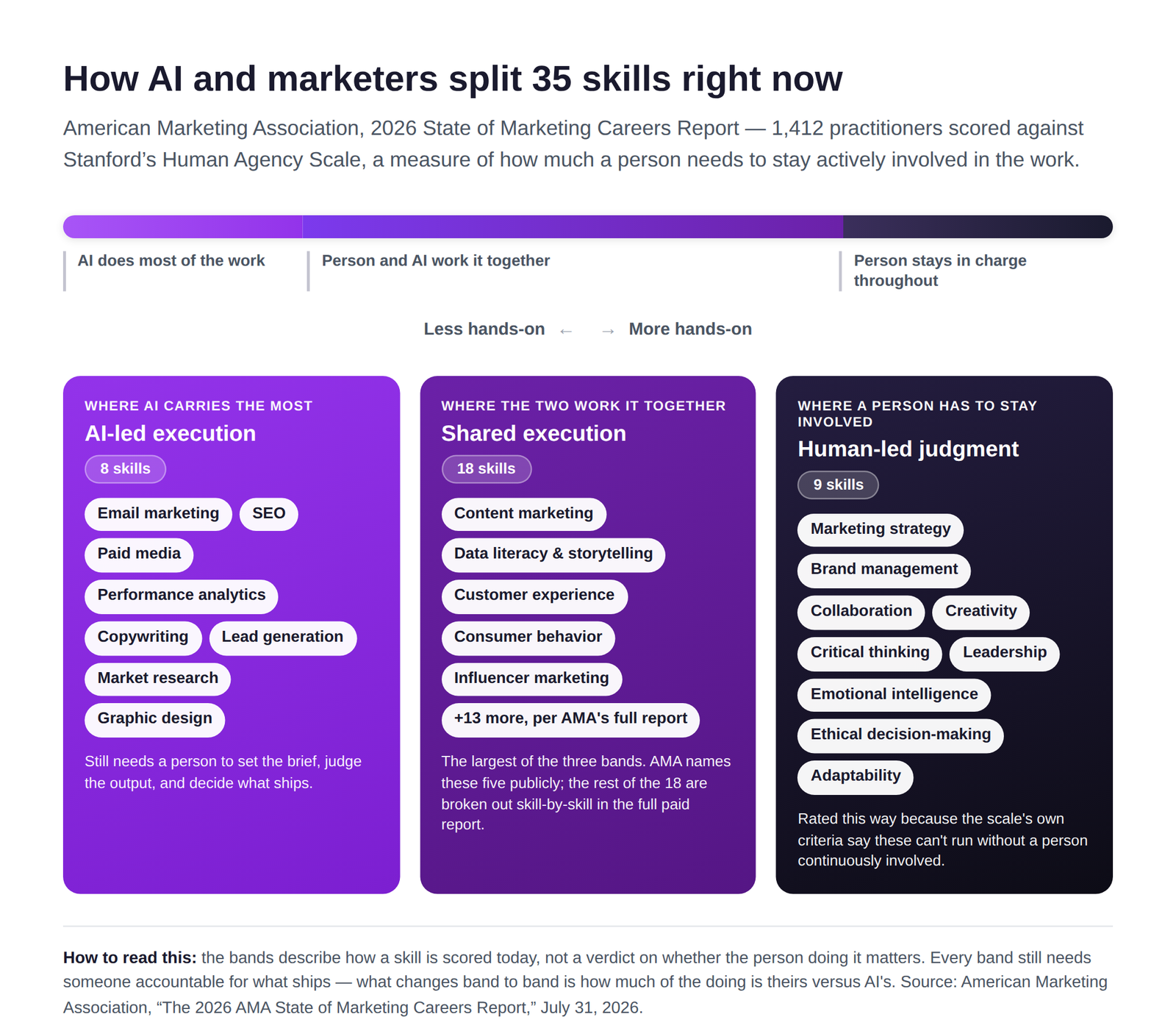
There’s real research behind this now. The American Marketing Association’s 2026 State of Marketing Careers Report surveyed 1,412 marketing professionals and mapped 35 marketing skills against Stanford’s Human Agency Scale, a measure of how much a person needs to stay actively involved in the work.[1] Eight skills sat toward the end where AI now carries most of the execution: email marketing, SEO, paid media, performance analytics, copywriting, lead generation, market research, and graphic design. Nine sat at the other end, where continuous human involvement still matters: marketing strategy, brand management, collaboration, creativity, critical thinking, leadership, emotional intelligence, ethical decision-making, and adaptability. A much larger middle group, eighteen skills in total including content marketing, customer experience, consumer behavior, data literacy and storytelling, and influencer marketing, sits in shared territory where AI and a person genuinely work it together.
That split makes intuitive sense once you look at what’s actually moving. AI is getting good at producing options, finding patterns, summarizing information, sorting volume, drafting first passes, comparing, reformatting, and recombining. What’s harder to hand over is choosing, prioritizing, interpreting, taking a position, understanding context nobody wrote down, noticing when something feels off, deciding which risk is worth taking, and standing behind the result. That’s the split I actually care about.
The six functions underneath those thirty-five skills spread out the same way. Paid media and analytics sit furthest toward repeatable execution. Content and design sit in the middle, fast at producing options, slower to judge what actually fits the moment. Social and brand strategy sit furthest toward judgment and accountability, doing less of the raw execution and more of the deciding.
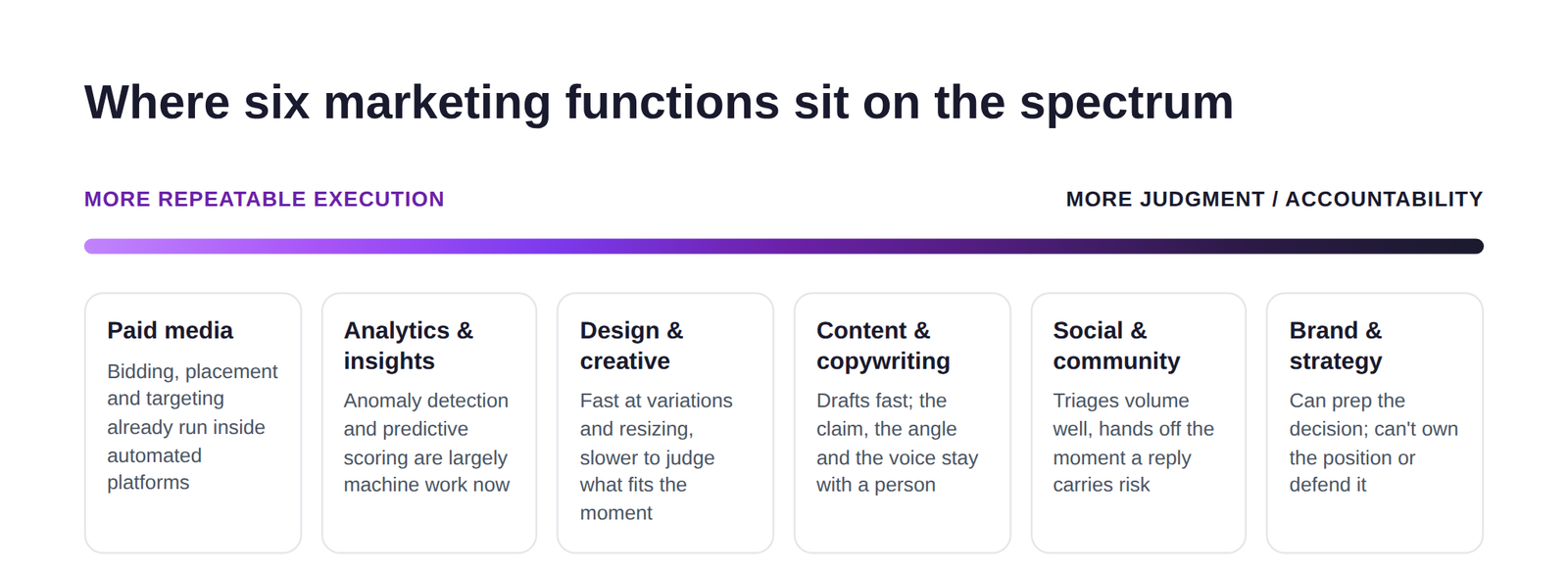
None of that is a ranking of which roles matter more. A task inside any of these six roles can move left or right on that spectrum depending on its own context, risk, and complexity, which is exactly why sorting by role is the wrong first move.
Take a social media manager. Ask whether “social media management” should be automated and you’ll get a useless answer, because the role is really eight or nine different tasks wearing one job title: monitoring mentions, sorting comments, drafting captions, adapting one post for LinkedIn, Instagram, and TikTok, answering a shipping question, answering an angry customer, deciding whether a joke is appropriate during a breaking-news cycle, managing a creator relationship, reporting results, and spotting a reputational issue before it grows. Same job title. Completely different work.
I sort tasks like that into three buckets.
| Give it to AI | Work with AI | Keep it human-owned |
|---|---|---|
| Repeatable, a clear standard for what “good” looks like, easy to verify, low consequence if it’s wrong: resizing assets, sorting comments, generating headline variants, formatting a report | AI speeds up the thinking or the production, but a person still shapes the direction: drafting copy, building a first-pass brief, researching competitors, exploring an audience angle | Judgment-heavy, high-context, high-risk, or the kind of call someone has to answer for: choosing the brand position, approving a sensitive reply, deciding what not to publish, owning the outcome if it goes wrong |
A task-level sort, not a role-level one. A single job usually has work sitting in all three columns at once. Original to Future Factors AI.
A writer might hand one task almost entirely to AI, work side by side with it on the next, and keep the third firmly human-owned, all in the same afternoon. That’s normal, and it’s the reason sorting the task always beats sorting the role.
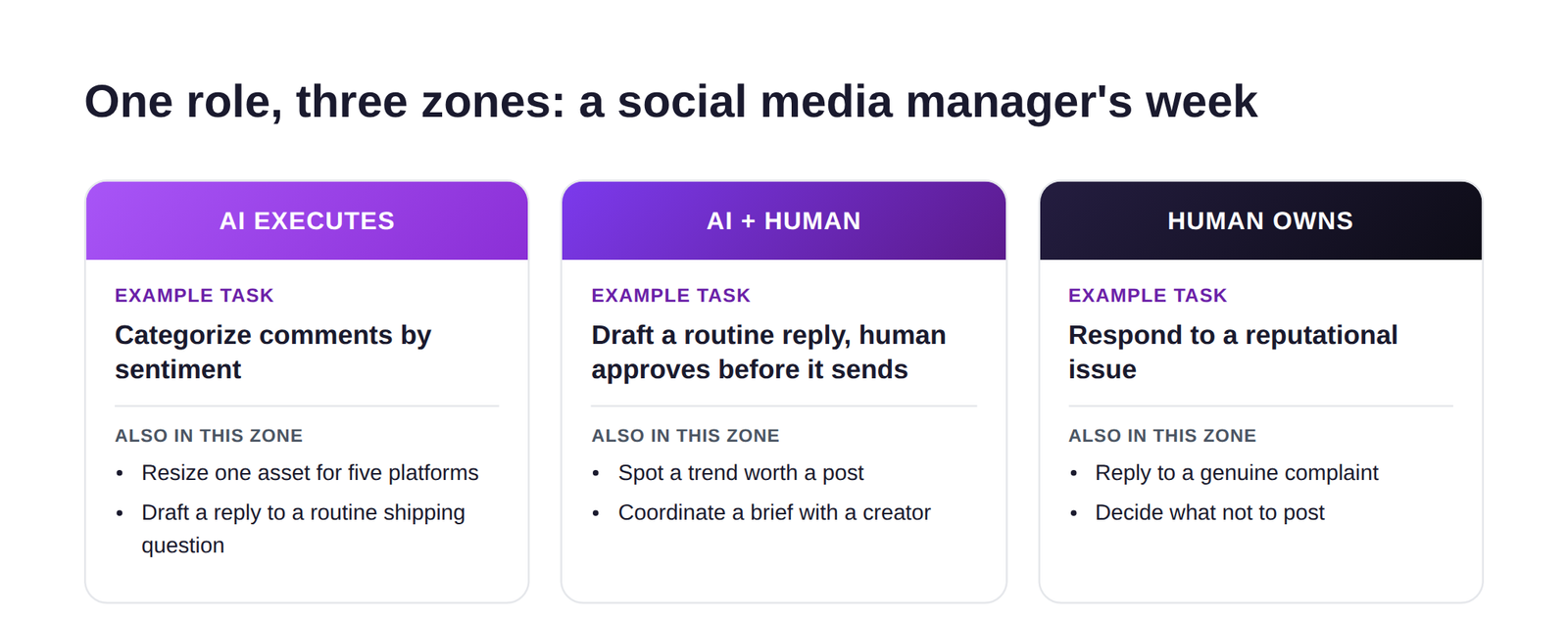
One person, three completely different relationships with AI, before lunch. That’s the whole argument in one picture.
Don’t automate the role. Redesign the work inside it, then be explicit about what AI handles, what the person still owns, and how it gets checked.
Sometimes the bucket is obvious. Other times, people on a team disagree, and that’s when I use a simple test I call SPLIT. I like it better than asking “can AI do it,” because at this point AI can produce something for almost any marketing task. That doesn’t tell you whether handing the work over is actually a good idea.
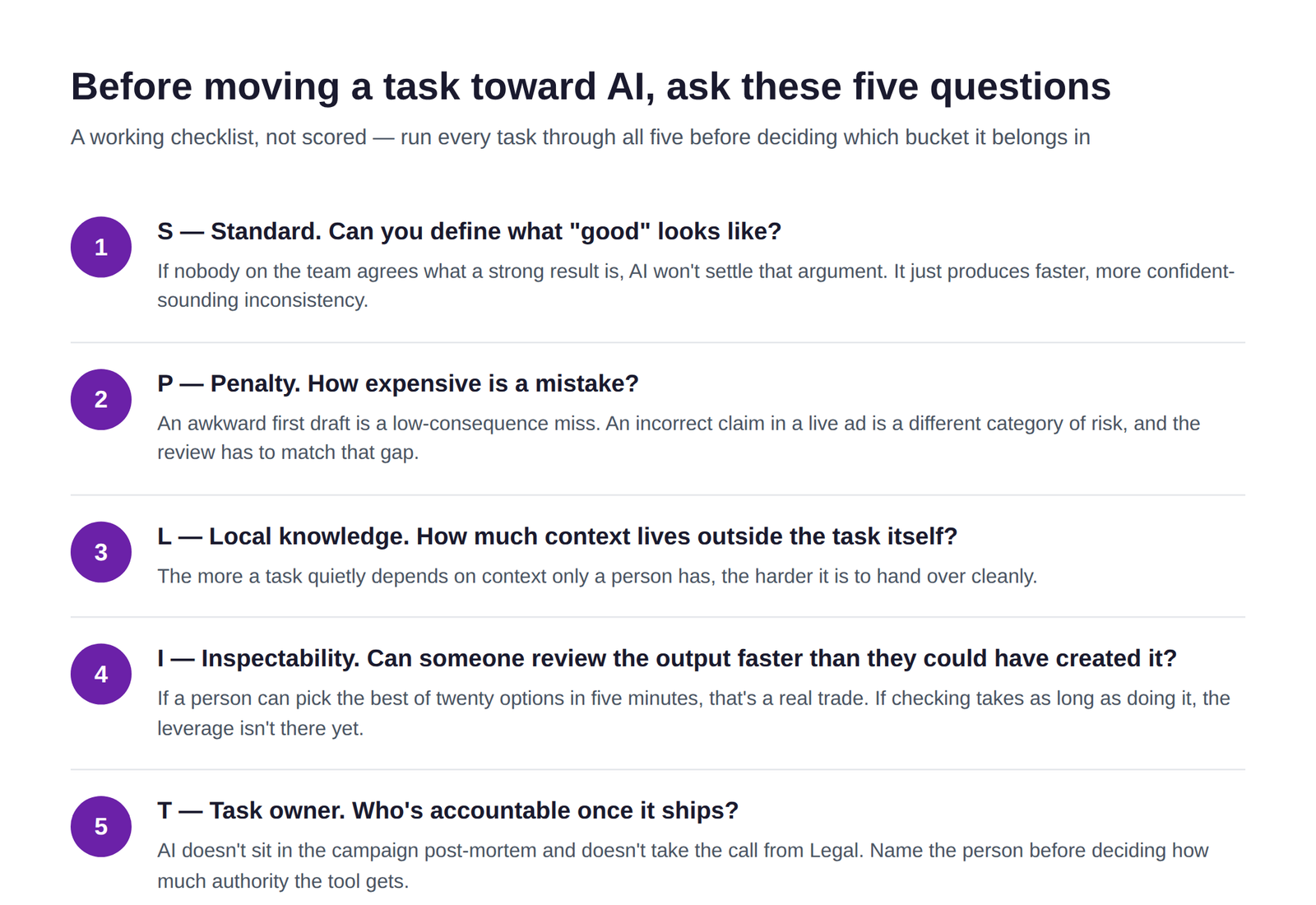
I’d keep the wording “working checklist, not a scoring rubric” on purpose. This isn’t about producing a magic automation score. One serious risk can override four favorable answers, and the test exists to make the conversation better, not to replace judgment.
Here’s the short version first.
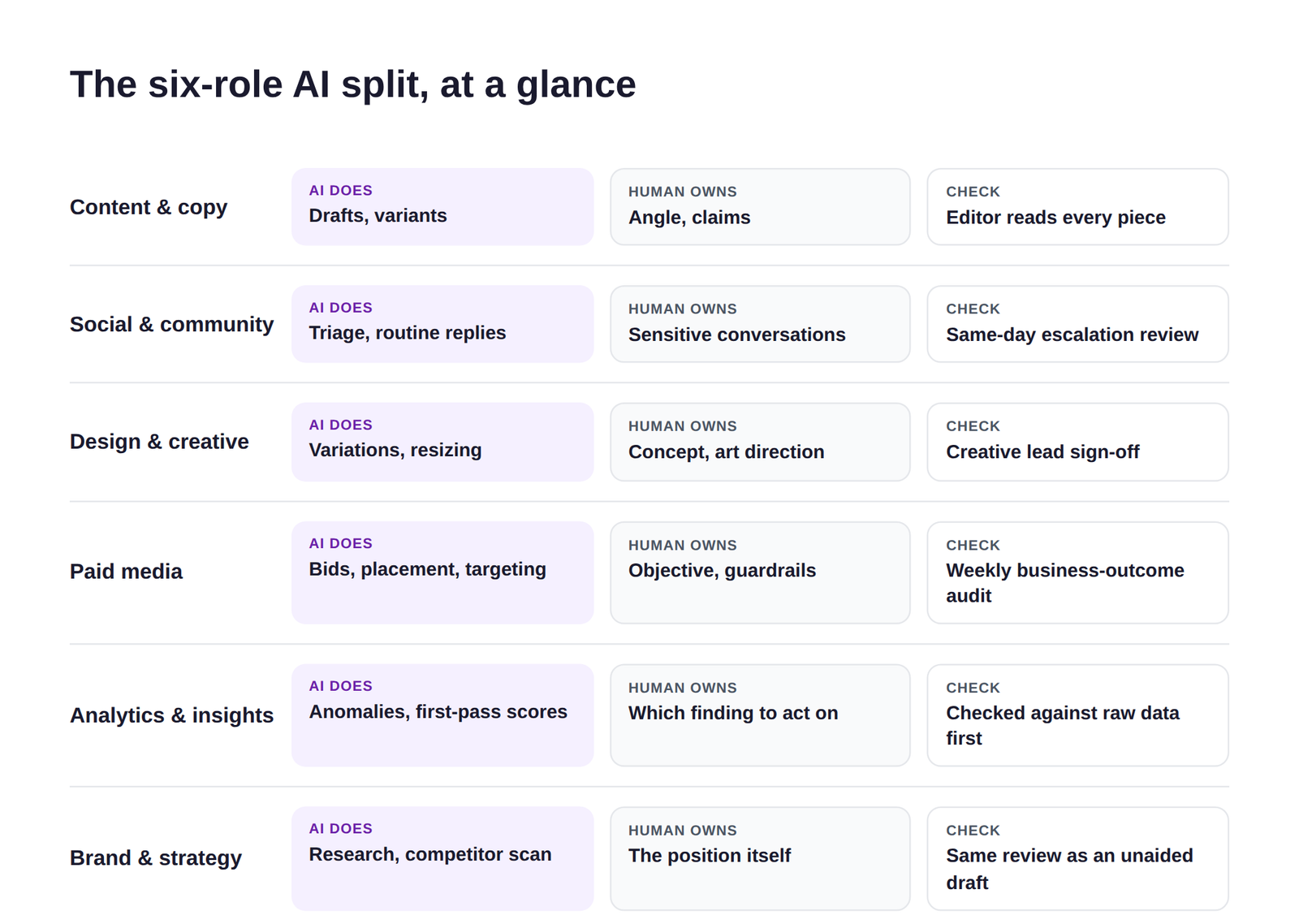
| Role | Give AI more of | Human owns | Check before shipping |
|---|---|---|---|
| Content & copy | Drafts, variants, outlines, repurposing, synthesis | Idea, angle, point of view, claims, editorial judgment | Facts, sources, brand voice, originality |
| Social & community | Monitoring, sorting, sentiment, routine drafts | Relationships, sensitive interactions, nuance, escalation | Reputation, context and risk |
| Design & creative | Production variations, rough concepts, resizing | Art direction, taste, originality, final selection | Brand, rights and accuracy |
| Paid media | Bidding, combinations, optimization, detection | Objectives, economics, guardrails, investment choices | Business outcomes beyond platform metrics |
| Analytics | Detection, querying, summaries, first-pass hypotheses | Interpretation, causality, context, recommendation | Raw data and competing explanations |
| Brand & strategy | Research, synthesis, scenarios, pressure-testing | Positioning, tradeoffs, strategic choice | Evidence and senior judgment |
A working register for a marketing team, built role by role. Original to Future Factors AI, not survey data.
The AI column usually gets most of the attention in these conversations. I think the middle column matters more: what is the marketer still responsible for. That’s where the role actually gets redrawn.
Content is usually where teams start with generative AI, and that makes sense, because the use case is obvious. Give AI a brief and you have a draft in seconds. Ask for thirty subject lines and you have them. Turn one webinar into an article, a newsletter, three social posts, and five sales snippets. I use AI for exactly that kind of work too.
But I think the content conversation got stuck for a while on the wrong question. “Can AI write?” Yes, that question is settled. The much more interesting one is what happens to the value of a marketer once producing competent words becomes cheap.
My answer is that judgment moves up the stack. The first draft matters less. The angle matters more, the customer insight matters more, the argument matters more, taste matters more. Knowing when a piece is boring matters more. Knowing when an AI-generated fact sounds plausible but needs checking matters more. And knowing when the smartest editorial decision is deleting half the draft matters more than anything else on that list.
I’ve seen AI produce a beautifully structured piece I would never publish. Nothing was technically wrong with it. That was the problem: there was no reason for anyone to read it.
So for content, I’m comfortable giving AI a lot of the blank-page work: outlining, first drafts, variants, repurposing, summaries, structure, even a first editing pass. I want the marketer keeping ownership of the idea, the claim, the perspective, and the final editorial call. One of my favorite tests here is simple: if you removed your logo and company name, could two hundred competitors publish this piece unchanged? If yes, you have content. You don’t have much of a point of view.
Before anything ships, I ask three questions: is this true, does this sound like us, and is this interesting enough to deserve someone’s attention. Grammar comes after all three, not before.
Social looks a lot like content until something goes wrong, and that’s when the difference becomes obvious. AI is genuinely good at volume. It can sort comments, flag sentiment, catch a spike, classify messages, and draft routine responses. Sprout Social’s 2026 moderation guidance describes hybrid moderation in almost exactly this shape: AI handles the obvious, large-scale screening while people take over wherever context and judgment matter, with a clear escalation path for anything touching legal, PR, or real supervision.[2] That’s how I’d design the work too.
A customer asks where an order is: AI can help draft the answer. A customer says the company discriminated against them: that’s a different workflow entirely. A journalist asks for comment in the middle of a public complaint: different again. The mistake is letting the technology make that escalation call by accident instead of on purpose. Draw the line before you need it, not during the moment you need it.
My rule here: let AI help sort the conversation. Let a person own the conversation once the relationship actually matters.
Creative AI makes a great demo. Type a description, ten visuals appear, change the background, resize for five platforms, try another style. That speed is real and useful. But I’ve also watched teams confuse more options with better creative, and those aren’t the same thing. If your team used to produce four campaign directions and now generates forty, somebody still has to decide which three deserve attention, and somebody still has to notice that option seventeen looks polished but feels completely wrong for the brand.
This is where taste stops being something you can wave off as subjective and soft. Taste is a decision system. An experienced creative lead knows what feels tired, what’s actually distinctive, what looks like a competitor’s work, what’s technically on-brand but emotionally wrong, and what plays fine in a deck but falls apart in market.
So yes, let AI help with concept exploration, background removal, resizing, mockups, and production variations. I’d keep a human firmly responsible for art direction, originality, cultural context, and the final creative call. My test: would we approve this if a human designer had made it? If the answer is no, “but AI made it quickly” isn’t a defense.
Performance marketing has been living with machine learning longer than almost any other marketing discipline. Automated bidding is old news, and so are audience expansion, campaign recommendations, placement optimization, and dynamic creative combinations. That direction is only getting more pronounced: Meta has announced plans to shift more placement decisions toward automated systems, including removing some advertiser-level placement exclusions, though at the time eMarketer reported the change, Meta hadn’t announced when the new rules would actually take effect.[3] IAB’s September 2026 update found 69% of US ad buyers were still increasing their focus on generative AI in media campaigns, down from 78% in January but still a clear majority.[5]
I don’t think that means the algorithm does the job now. It means the valuable part of the job moves. Less manual adjustment, more interrogation: what did the platform change, why, what metric did it optimize for, and does that metric actually represent what the business cares about. A cheap lead looks fantastic until Sales tells you none of them qualify. A lower cost per acquisition looks fantastic until customer quality falls. A high click-through rate looks fantastic until nobody converts.
That’s why I like the idea of a standing weekly algorithm audit. Don’t just review the results, review what the automation actually did: what it favored, what it suppressed, where spend moved, what it learned, what it optimized away, and whether any of that still lines up with the business objective. That’s becoming a core media-buying skill in its own right.
This is one of the places AI feels almost magical the first few times you use it. Hand it a large data set, ask what changed, ask for anomalies, ask for segments, ask for hypotheses, and you get to interesting questions much faster. Google Analytics already generates predictive metrics like purchase probability, churn probability, and predicted revenue for eligible properties.[4] Useful, yes. A decision, no.
Say the model tells you conversion fell eighteen percent and points to campaign fatigue. Maybe. Or your tracking broke, or inventory changed, or a discount expired, or your media mix shifted, or Sales quietly changed the qualification criteria, or a competitor launched something. One of the habits I push hardest with teams is separating “here’s what the data shows” from “here’s why I think it happened.” Those aren’t interchangeable, even though AI tends to collapse them, because language models are very good at producing a coherent explanation, and coherent isn’t the same as proven.
So I like AI handling the finding, the sorting, and the hypothesis generation. I want the analyst owning interpretation and the recommendation. Before an AI-generated insight reaches a leadership meeting, I’d check the underlying number, confirm the data source, generate at least one competing explanation, and ask what evidence would actually disprove the preferred one. My shorthand: AI can tell you what appears to have changed. Make the explanation earn its way into the decision.
I hear two extreme positions on AI and strategy. One says strategy is inherently human and AI has no place in it. The other says you can just ask a model to produce the strategy now. I don’t buy either one.
AI is genuinely useful in strategic work: competitor synthesis, interview analysis, market scanning, scenario generation, research organization, contrarian arguments, assumption testing, finding a pattern across a pile of material no strategist wants to reread for the fifth time. I want AI doing as much of that groundwork as makes sense, because I’d rather have the strategist spending her time on the part that actually earns the fee: what does this mean, what are we going to do about it, which customer are we prioritizing, which position are we willing to own, which opportunity are we saying no to, what tradeoff are we willing to defend.
Defend is the word that matters. Strategy isn’t an impressive list of possibilities, it’s a commitment, and somebody has to own that commitment when the evidence is incomplete and reasonable people disagree. So the rule I use is narrower than “strategy stays human.”
Let AI improve the thinking. Keep the strategic commitment human-owned.
Picture a 25-person B2B marketing team. Leadership buys one AI platform for everyone, schedules a two-hour training, and the whole department attends. Everyone learns the same prompting framework. Then leadership sets a target: use AI in at least one workflow every week, tracked by login counts.
Three months later the login numbers look good. Twenty-one of twenty-five people have used the platform. The dashboard is green. Then you look at the actual work. The writers use AI constantly, because the connection to their job was obvious. The paid media team barely changes anything, because half their execution was already automated inside Google and Meta. The brand strategist has experimented a few times but still can’t name the recurring workflow leadership expected her to change. The social team writes captions faster, but the same two-day approval chain is still there. The designers now produce three times as many concepts, and the creative director now has three times as many concepts to review.
Everyone “adopted AI.” Whether marketing actually got better is a different question. This scenario is illustrative, not a named client engagement, but the shape shows up again and again. The problem was never the training. Nobody translated a department-level ambition into role-level work.
| Function | The blanket version (what didn’t work) | The role-specific version (what worked instead) |
|---|---|---|
| Content & copywriting | “Write faster with AI” | Use it for first drafts and headline variants; every piece still gets a human edit before it ships |
| Social & community | “Use AI for engagement” | Let AI triage volume and draft routine replies; a person owns anything carrying complaint or reputation risk |
| Design & creative | “Generate more assets” | Use AI for concept exploration and production; the creative lead still owns direction and final approval |
| Paid media | “Use AI more in your campaigns” | Audit what the automation decided every Friday against the stated budget goal, not just the platform’s own reported win |
| Analytics & insights | “Use AI to find insights” | Let AI surface anomalies and first-pass summaries; the analyst validates the data and owns the interpretation |
| Brand strategy | “Try using AI this quarter too” | Use it to summarize competitor research before a positioning session; the position itself stays hers to defend |
The same rollout, rebuilt role by role instead of team-wide, now covering all six functions.
That’s the difference between buying access and designing adoption.
Tell each role what it’s keeping, not just what’s changing.
There’s a change-management problem hiding inside all of this. When leaders introduce AI, they often reach for language like “AI will free you up for higher-value work.” I understand why, it sounds positive. The problem is that higher-value work is an empty phrase if nobody tells you what your job actually becomes.
So I’d rather hear something specific, role by role. To the copywriter: AI is taking more of the blank-page work, you still own the idea, the point of view, the claims, and the final copy. To the designer: AI gives you more ways to explore quickly, you still own visual judgment and final creative direction. To the media buyer: the platforms are handling more execution, your role moves further toward objectives, economics, and auditing what the automation decided. To the analyst: AI will do more of the finding and summarizing, you still own whether the explanation actually holds up and what the business should do about it. To the strategist: AI can accelerate the work underneath the recommendation, the recommendation is still yours.
People don’t need vague reassurance. They need a clearer picture of what stays theirs.
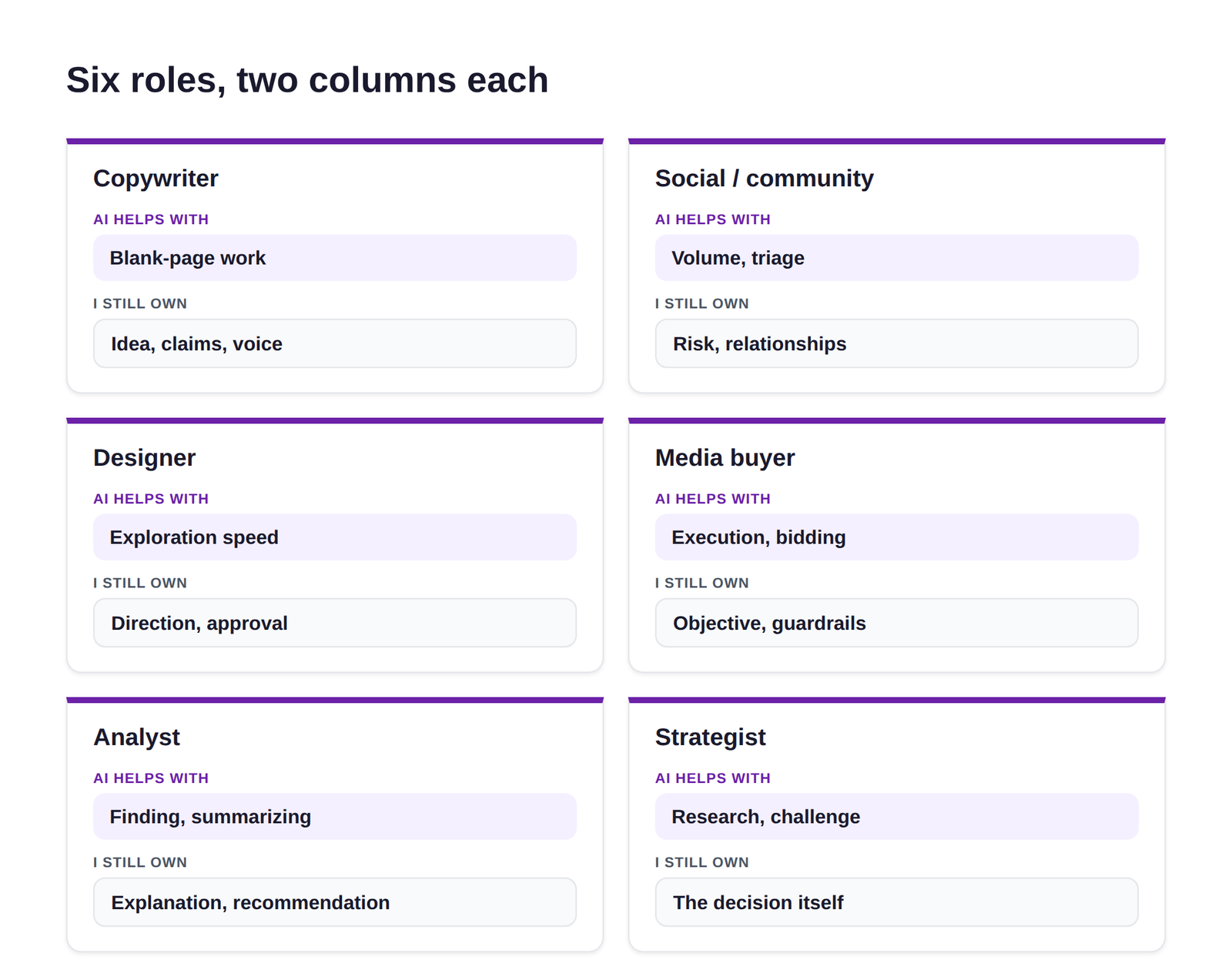
I believe in common foundations. Everyone should understand context, know how to verify output, and understand hallucinations, data boundaries, and the basics of a good prompt. Then I’d split the room, because a media buyer, a strategist, a writer, and an analyst shouldn’t spend the rest of the day practicing the same task.
The writer should practice taking a research-rich brief, using AI to explore a few directions, then judging which one has something worth developing. The media buyer should practice challenging an automated recommendation and deciding when to override it. The analyst should take an AI-generated explanation and try to break it. The strategist should hand AI the same source material twice, ask for competing interpretations, and decide which position the evidence actually supports.
That’s when training starts changing the work. Not when someone learns a clever prompt.
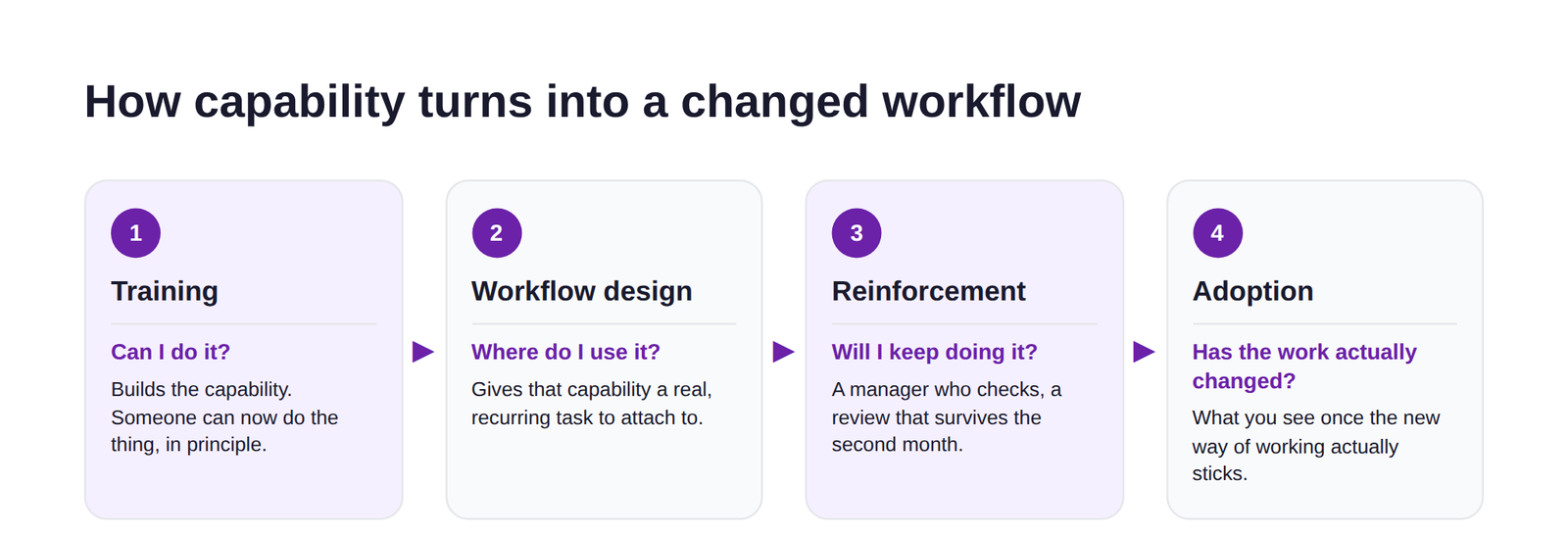
Training answers can I do this. Workflow design answers where this fits. Reinforcement answers will I keep doing it. Adoption answers has the work actually changed. Training is one piece of that chain, not the whole thing, which is easy to forget when it’s the only piece most companies budget for.
Don’t start by transforming the entire department. Pick one recurring workflow, campaign development works well as an example. Today it might look something like: audience research, review of the previous campaign, the brief, the campaign angle, copy, creative, review, approval, launch, measurement.
Break each stage into smaller tasks. Run those tasks through SPLIT. Assign each one to give-it-to-AI, work-with-AI, or human-owned. Name the review point. Then run the workflow on real work, not a practice exercise nobody’s accountable for. Two weeks is usually enough to find the obvious friction.
Afterward, don’t just ask whether people liked using AI. Ask whether the work got faster, whether quality held, where human time went down and where it went up, whether anyone quietly redid AI-generated work by hand anyway, whether the approval burden grew, whether AI introduced new errors, and whether the bottleneck simply moved somewhere else. That last question, whether the team would keep using the new workflow if the manager stopped reminding them, tells you more about real adoption than any login dashboard.
This is one of the most common mistakes in AI productivity measurement. A team reports that AI cut drafting time by sixty percent. Great news, until you ask what happens next. If the same subject-matter expert now has twice as many drafts waiting for review, the bottleneck didn’t disappear, it moved.
A designer generates campaign concepts in two hours instead of two days, and creative approval still takes three days, so the total campaign cycle barely changes. A social team writes replies faster, and every response still waits in the same approval queue. A performance platform makes more decisions automatically, and nobody has checked whether its optimization goal still matches the business goal. Whenever AI makes one stage faster, I ask what happens immediately after that stage. That question uncovers the next real problem faster than another round of AI use-case brainstorming ever does.
I wouldn’t use logins as the main measure of AI adoption in marketing. A login tells you somebody opened a tool. That’s about it. I use three questions instead: are people using the redesigned workflow, that’s use. Are they still using it a month later without being reminded, that’s persistence. Did the work actually get better, that’s impact.
Imagine five content marketers. Four try the AI-assisted drafting workflow this week, that’s use. A month later, three still use it without being chased, that’s persistence. The team then sees the time from an approved brief to a client-ready first draft fall materially, while quality stays at the expected standard, that’s impact.
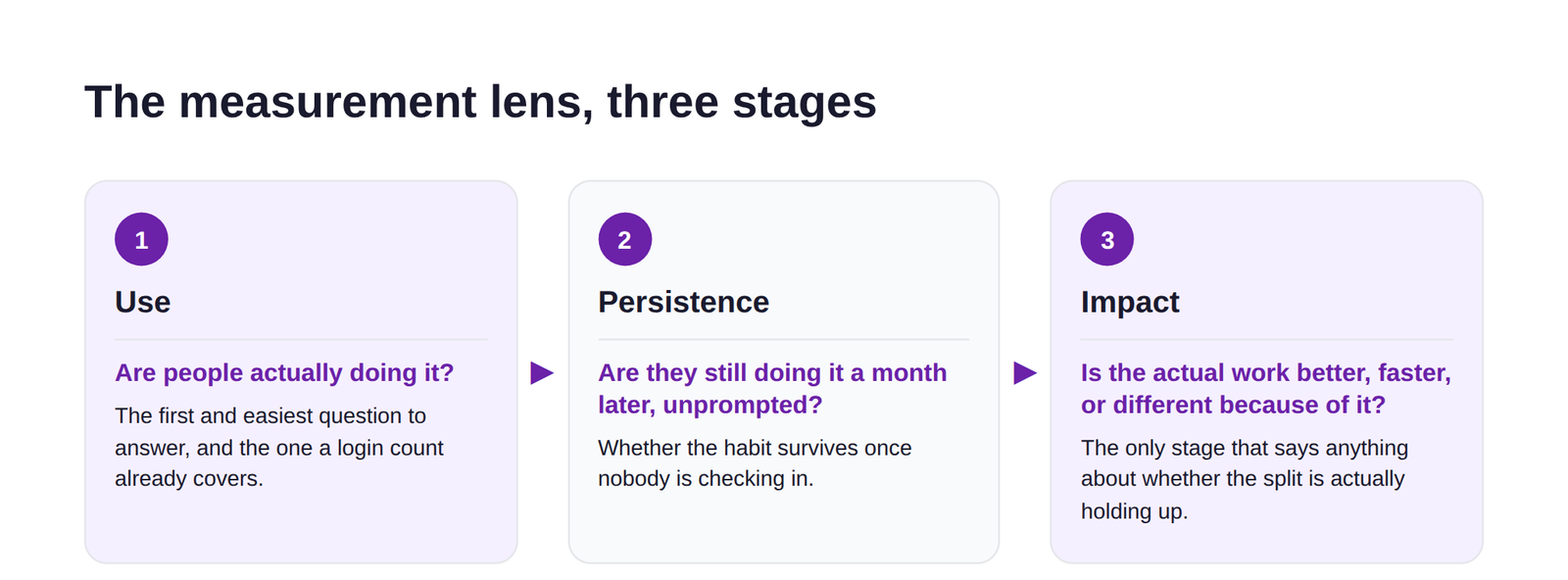
Quality is the gate here, not an afterthought. There’s no prize for adopting a worse way of working faster. And I wouldn’t compare raw AI activity across jobs either: a performance marketer interacts with machine-driven systems every day, while a strategist might use a heavy AI workflow during a quarterly positioning review and barely touch it in between. Those two jobs run on different clocks. Measure each redesigned workflow against its own outcome, not against another role’s.
Step back and something consistent shows up. The writer spends less time staring at a blank page, and the value shifts toward ideas, editing, and evidence. The designer gets more possible directions, and the value shifts toward taste and creative choice. The analyst spends less time pulling information together, and the value shifts toward interpretation. The media buyer manually controls fewer execution decisions, and the value shifts toward objectives, economics, and auditing the machine. The strategist can absorb far more research, and the value shifts toward deciding what actually matters and committing to a direction.
AMA’s own 2026 report argues something similar: as AI takes on more execution, skills like discernment, decision-making, strategic thinking, quality control, taste, and business judgment become more important, not less.[1] I think that’s the more useful way to talk about the future of marketing work. It isn’t simply that AI does more and humans do less. AI does more of some kinds of work, and the human contribution moves, and in most marketing jobs, it moves closer to judgment: what should we say, what do we believe, which customer matters, what’s actually worth making, what are we willing to put our name behind, where is the machine wrong. Those are still marketing questions. They just sit in a different place in the job than they used to.
If I were starting with your team this week, I wouldn’t open with a department-wide transformation plan. I’d pick one role, then one recurring workflow inside it. Break that workflow into tasks. Run each one through SPLIT. Write down three things: what moves to AI, what the marketer still owns, and how the result gets checked. Test that version on real work, measure what happens, fix what breaks, then move to the next workflow.
That’s slower than sending out a “use more AI” directive on a Monday morning. It’s also far more likely to actually change how your team works by Friday.
The question I keep coming back to isn’t really whether AI can write, analyze, design, research, or plan a strategy. In some form, it can. The harder question is how you divide the work so AI gives your marketers real leverage without making the judgment, the quality, or the accountability fuzzy. That’s not a tooling problem. It’s a work-design problem, and for marketing leaders, that’s where the real work starts.
AI now carries most of the execution on eight skills, according to AMA’s 2026 Human Agency Scale mapping: email marketing, SEO, paid media, performance analytics, copywriting, lead generation, market research, and graphic design. A person still has to stay involved throughout on marketing strategy, brand management, collaboration, creativity, critical thinking, leadership, emotional intelligence, ethical decision-making, and adaptability, because the scale’s own criteria say those can’t run without someone continuously there.
Start everyone on the same foundations, prompting, context, verification, and model limitations, then split the room. A copywriter, a media buyer, an analyst, a designer, and a strategist are facing different tasks, different risks, and different review standards, so identical practice after the basics tends to bore the people furthest along and confuse the people who haven’t started.
The stronger evidence points to tasks and skill mixes changing rather than whole functions disappearing in one direction. AMA’s 2026 research found execution-heavy tasks under more pressure while judgment-heavy work in the same roles becomes more valuable. Influencer marketing, a role built on relationship and creative judgment rather than production volume, was the fastest-growing marketing job the report tracked even as more execution-focused roles softened.
Run it through the SPLIT test: can you define the Standard for a good result, what’s the Penalty if it’s wrong, how much Local knowledge does it depend on, can someone Inspect the output faster than they could create it themselves, and who’s the Task owner once it ships. A task that’s repeatable, has a clear standard, and carries a cheap mistake usually goes to AI. A task with real context, real risk, or someone’s name on the outcome stays human-owned, no matter how good the first draft looks.
Starting with how do we get everyone using AI more instead of which work should actually change, and how. A blanket mandate can raise login numbers without changing a single workflow underneath them, which is how a team ends up with a green adoption dashboard and the same bottlenecks it had before.
This article draws on five sources, listed below: the American Marketing Association’s 2026 State of Marketing Careers Report and its Human Agency Scale skill mapping, Sprout Social’s 2026 guide to social media moderation tools, eMarketer’s August 2026 reporting on Meta’s shift toward fully automated ad placement, Google’s own documentation of GA4’s predictive metrics, and MarTech’s September 2026 coverage of the IAB’s 2026 Outlook Study September Update (the IAB’s own page for that update sits behind a free-registration wall, so the fully readable MarTech write-up is linked instead). All five were re-checked against the live source in September 2026 and nothing had moved since the last update. The 25-person rollout described in this piece is a labelled, illustrative scenario built to show a common failure pattern, not a real client engagement, and the five-content-marketers example in the measurement section is an illustrative walkthrough of the Use, Persistence, Impact lens, not a reported result from any real engagement. The SPLIT test, the task-sort spectrum, the three-zone social media example, the role-by-role register and its compressed summary, the six-role rollout comparison, the training-to-adoption chain, the role cards, and the measurement lens are all original to Future Factors AI, not survey data.